“It came from the woods. Most strange things do.”
— from “Through the Woods” by Emily Carroll
As someone who likes moody gothic horror, I was drawn to Emily Carroll’s graphic novel “Through the Woods,” which offers five beautifully, gloomily illustrated tales.

These deliciously doom-laden confections are united by a preoccupation with the shadowy, often predatory and unwholesome things that come out of … and sometimes venture into … that most primordial and archetypal of locales: the woods. The pictorial style is pastoral, vaguely 19th century, sometimes rich with color; sometimes a subdued monochrome scene is enlivened by jarring swathes of red, as if an artery had opened out of the black ink of the page.
As a side note, I’m not a voracious reader of graphic novels. I dip into them occasionally. I’ve read a few significant ones such as Art Spiegelman’s unforgettable memoir of Holocaust survival, “Maus,” but I’m far from an expert.
I know that reviewing a graphic novel means you can’t approach it purely on a literary basis. You have to look at it as a package, a literary and visual experience in which the words and pictures go hand in hand, often with the pictorial component staking the greatest claim for our admiration and attention.
This might sound obvious, but I put it in writing as a reminder to myself: Don’t just talk about the words. Talk about the pictures! (In college, I got an A minus on a paper written for a music appreciation class about Mozart’s “Don Giovanni.” The “A” part was because the teacher said my paper was well written. The minus was because I stayed in my comfort zone and wrote almost exclusively about the narrative elements. The teacher, whose grading was perhaps generous considering it was indeed a music course, commented: “You hardly said anything about the music.”)
“It was a tall man in a wide-brimmed hat, with a smile that showed all his teeth.
Back to “Through the Woods.” It begins with a tale, “Our Neighbor’s House,” about three sisters left to fend for themselves in an isolated house when their father goes off hunting. An ominous visitor, a tall man in a wide-brimmed hat “with a smile that showed all his teeth,” comes calling in the night, seeking out each of the sisters in turn.
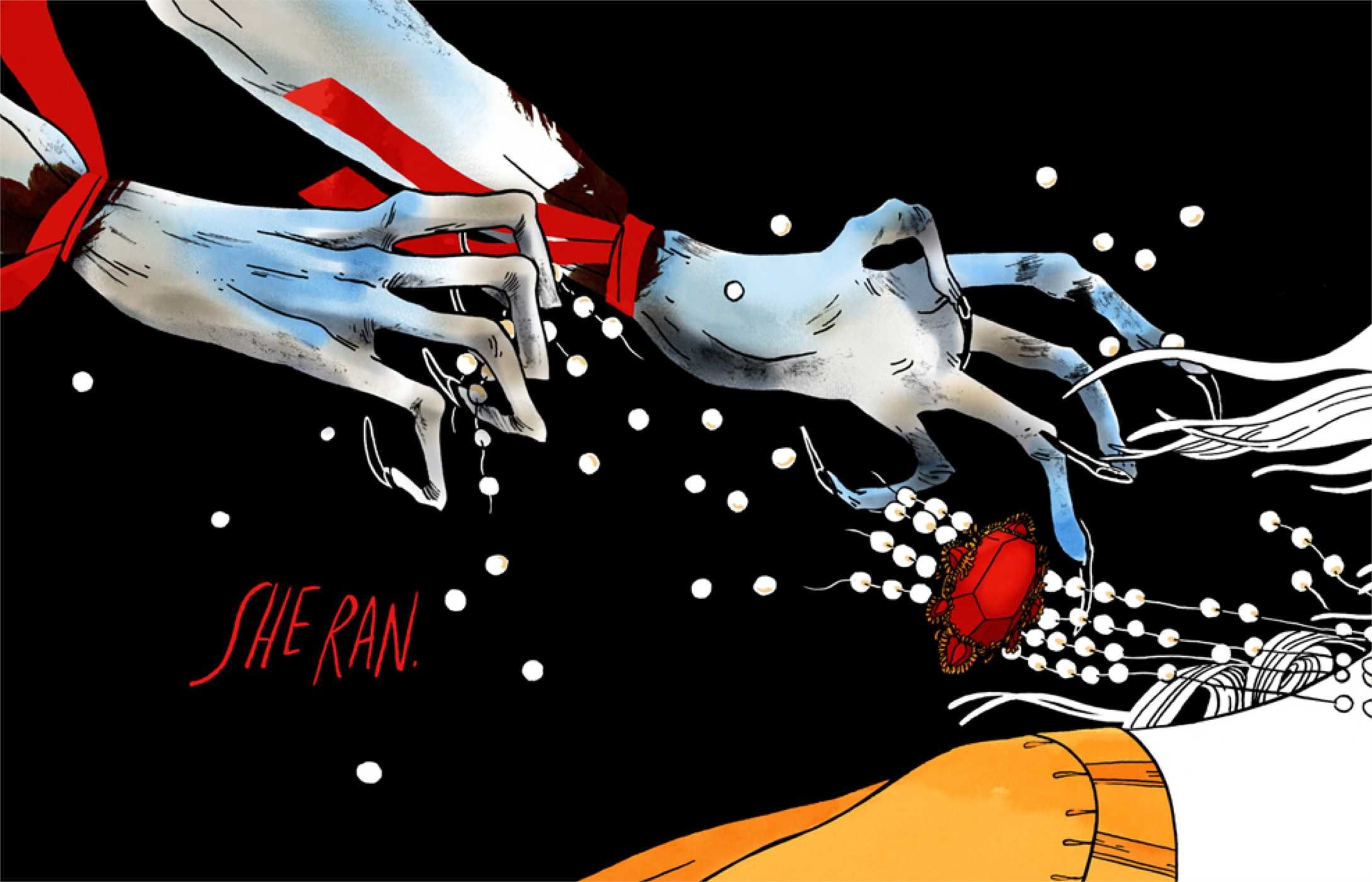 A riff on the “Beauty and the Beast” motif follows in the form of “A Lady’s Hands are Cold.” (Carroll has a gift for titles that put a chill in the atmosphere from the start.) A young bride. A magnificent, lonely castle. A brooding mysterious groom, cold, handsome and remote. And a grisly secret hidden in the walls that suggests this young bride is not the first young beauty to grace this imposing home, and not the first to be wed to its master.
“She told her of the man-shaped thing that lurked in the cellar of her childhood home. How its bone-white face, with its piano key teeth and burnt-out eyes, would peer up from the bottom of the steps.”
“His Face All Red” is a story about brothers. One is shy, retiring, lacking in confidence. The other is handsome outgoing, blessed with a splendid cottage, a comely wife, and the respect and admiration of all in the village. Together, the two hunt the beast that is terrorizing the village. But what really happens? And why, afterward, is the popular brother glimpsed hanging out at the village pub … when he is supposed to be dead?
“My Friend Janna” is a young lady with, seemingly, a psychic gift … but her loyal companion Yvonne is the one who can really see spirits. Is the one she sees hovering over Janna a blessing … or a deadly curse?
In “The Nesting Place,” Bell, grieving for her mother, comes to live with her brother and his bride, a tall and elegant beauty named Rebecca. But Rebecca is not all she seems … or perhaps she is something more. Her secret has to do with things that squirm and crawl in a cave in the woods. Things that Bell overhears Rebecca talking lovingly to.
“There are wolves circling in the dark.”
The stories are united by themes of jealousy, distrust, familial loss and bitterness. All paths lead to and from the woods. There, wreathed in the fetid damps of the tree-choked forest, Carroll unveils the darkness of the human heart.
Carroll’s gift for character delineation is impressive. Sometimes they are dashing, full of life. More often, they are sulky, lumpy and non-prepossessing. Our attention is arrested by odd, disquieting details. Why does Bell walk with a brace? (Well, why shouldn’t she?) All of these characters are unique, living, breathing individuals. None will be deterred from the grim little journey destiny has mapped out for him/her.
Is this a novel, or a series of horror comics tied together with a thematic bow? The endings are not as twisty and pungent as the best of “The Twilight Zone,” certainly not assumption altering like “The Sixth Sense.” Rather than lean strongly on a sense of narrative resolution, they leave us feeling uncertain, haunted by questions and disquieting visuals that gnaw at the memory.
The images linger on. A grinning white face peering from a cellar’s dark recesses. Three sisters stretched out in a stuporous languor on a living room rug. A woman’s face transformed into … or is it revealed to be? … a sea of red spaghetti-like strands and teeth. Disembodied lupine eyes and fangs hovering in darkness outside the frame of a child’s window.
The woods, with its wicked secrets, awaits your pleasure.
Buy “Through the Woods” by Emily Carroll from Amazon.com and read Emily Carroll’s blog.


