Movies

All posts in the Movies category

DAY 1 OF 31: DRACULA (1931)

Published October 1, 2022 by Philip Ivory


The first supernatural drama of the sound era, DRACULA was unleashed by Universal on Valentine’s Day 1931 with the tag line “The Strangest Love Story Ever Told,” perhaps signalling the studio’s unease at peddling such a bloodcurdling tale to a nation in the grips of the great depression. They need not have worried. The film provided a kind of rich Gothic escapism, paving the way for a whole cycle of 30s atmospheric chillers made with artistry and care that drew healthy box office and crowned Universal the king of horror. 

An adaptation of Bram Stoker’s 1887 classic, DRACULA also had its roots in a successful stage version, from which the play’s star, Bela Lugosi, was recruited to play the lead. The familiar tale tells of the vampire king’s migration from his native Transylvania … an exotic locale seen to great effect in one of the most eerie opening sequences of any horror film … to London’s teeming metropolis.
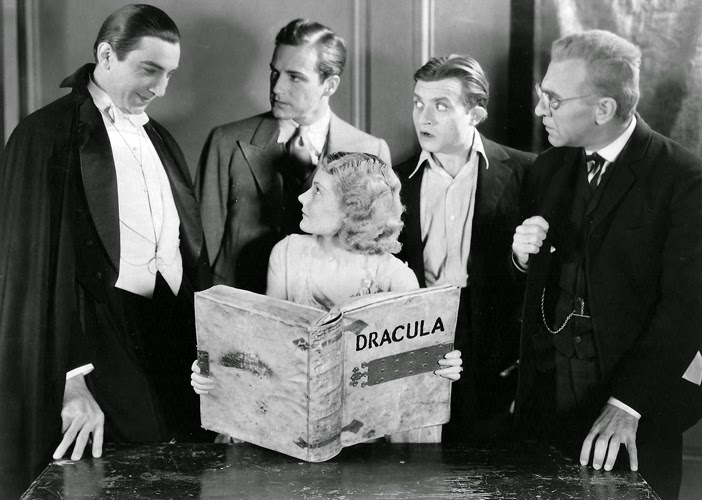
The cast of DRACULA: Bela Lugosi, David Manners, Dwight Frye, Edward Van Sloan and Helen Chandler.

The Count insinuates himself into the company of a group of unsuspecting Londoners, including the wise and virtuous Mina and her perhaps less wise best friend Lucy, who thrills to Dracula’s grand manner and exotic accent.

Lucy is attacked, dies and is resurrected as a vampire herself only to end up on the fatal end of a stake driven into her heart by intrepid and learned expert on the supernatural, Dr. Van Helsing, in a sequence that should have been a horror highlight but takes place off screen. (The film is too reticent in many places, conveying important plot points second hand through dialogue, when we would much rather have seen them directly.) 

Dracula sets his sites on Mina, who is defended by her boyish fiance, Jonathan, sanitarium director Dr. Seward, and Van Helsing, who warns his friends, “The strength of the vampire is that people will not believe in him.” In the end, Van Helsing and Co. track Dracula to his London hideout and good prevails.

HIGH POINTS

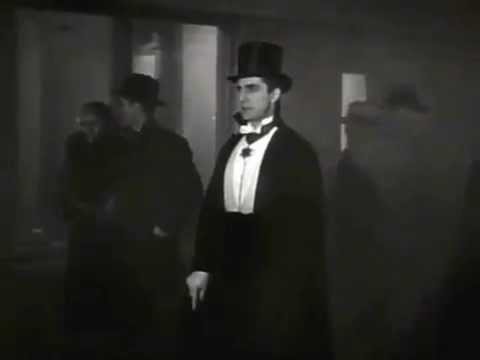
The film offers a classic performance by Lugosi himself, whose authentic accent, strange bearing and bizarre, halting cadences (“I never drink … wine.”) contribute to an unforgettable portrait of evil. I remember being particularly perturbed at the disembodied way Dracula drifts through a London street scene, before settling on a poor flower girl for an evening bite. He conveys the aspect of someone controlled from afar, perhaps an expression of how Dracula is held in thrall to a greater infernal power.  I’ve never seen any other actor in the part hint at this particularly eerie quality.
And while no more than a drop of blood is scene in the film, Lugosi achieves a heightened sense of horror through body language — he’s like a stylized vulture in a bedroom scene as he descends upon his victim –and facial expression. His striking mix of bestial hunger and a kind of pained self-revulsion while in the predatory moment is unforgettable.
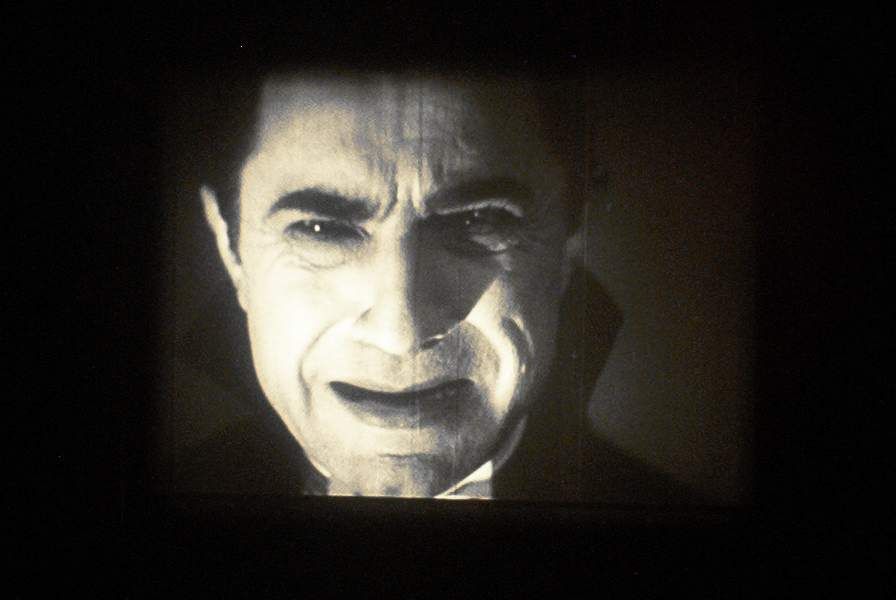
Also memorable are Van Sloan as the anti vampire crusader Van Helsing, and Dwight Frye (like Lugosi and Van Sloan, repeating his performance from the stage) as the pathetic fly-eating mental patient who has fallen under Dracula’s sway. Frye in particular has some wonderful moments, including his eerie demented laughter issuing from the hold of a deathship full of Dracula’s victims, and his “Rats, rats, rats” monologue in which he describes the vision of teeming life offered to him in return for faithful service to his master.
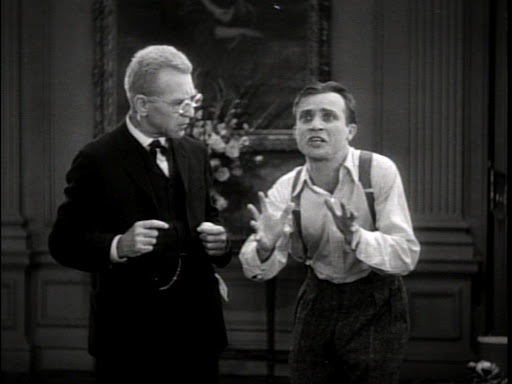
“A red mist spread over the lawn, coming on like a flame of fire … Rat, rats, rats. Thousand of them. Millions of them. All red blood.”

DRACULA is memorable for its elegant dialogue, these three tidbits all coming from the Count himself:

(hearing the howling of wolves) “Listen to them. The children of the night. What music they make.”

“I never drink … wine.”

“To die, to be really dead. That must be glorious … There are far worse things awaiting man than death.”

DEFICITS

The film is justly slated for being stagey, not taking advantage of the adventurous sweep of Stoker’s saga, which ends in a desperate race back to Dracula’s castle, a sequence which held great filmic possibilities but wasn’t used. And while I think Helen Chandler is fine as Mina, particularly in a scene in which her eyes light up with bloodlust as she battles to restrain herself from attacking her fiance’s handsome throat, I think David Manners is stiff and awkward as her reliable lover. Comic relief provided by a cockney sanitarium attendant mostly falls flat today.

Director Todd Browning seems a bit sloppy in places, as when those little spotlights for Lugosi’s eyes don’t quite find their mark:
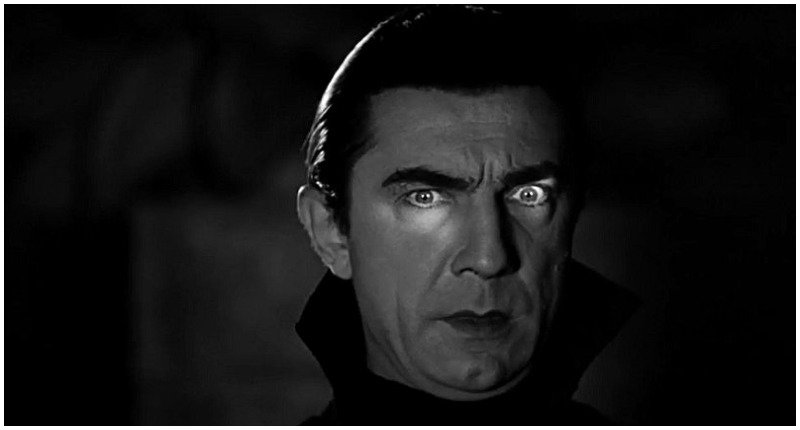
And if you’re really into the minutiae of classic films, check out this ten minute youtube exploration of why an ugly, jagged piece of cardboard can repeatedly be spotted in some of the bedroom scenes:

Caveats and technical deficiencies aside, DRACULA still has wonderful moments of poetic dread and horror, and remains a classic and standard bearer for all monster movies that followed in its wake.

UP NEXT:

“You have created a monster, and it will destroy you!”


During October: 31 Days of Classic Horror

Published September 30, 2019 by Philip Ivory

From my earliest years, horror films have had a profound influence on my creativity and my writing, and it’s time I paid them proper tribute for their artistry and lingering cultural impact.

Starting tomorrow and continuing each day for the entire month of October, I’ll highlight a favorite horror film, one that’s particularly influential in the field, or that impacted me in a profound way. The choices are subjective and entirely mine. The list will proceed chronologically from the dawn of sound films to the present day. 


Please check in and help me celebrate the cinema of the macabre all this month. Like Dr. Septimus Pretorius in BRIDE OF FRANKENSTEIN (1935), let’s hoist our glasses and toast the infernal, unholy, misbegotten and malign:

“To a new world of gods and monsters!”


COPD: Highly Illogical … an upcoming film about Leonard Nimoy

Published March 1, 2016 by Philip Ivory

Embed from Getty Images

Click here to see the trailer for COPD: Highly Illogical.

The trailer for the upcoming film “COPD: Highly Illogical” is narrated by  John de Lancie (“Q” of “Star Trek: The Next Generation”) and features Julie Nimoy, daughter of beloved actor Leonard Nimoy of “Mr. Spock” fame.  Leonard Nimoy died just over a year ago of complications related to Chronic Obstructive Pulmonary Disease (COPD).

I’m very excited to be involved in this important project, which will be released later this year, during the 50th anniversary of the debut of the original “Star Trek.” I’m proud to have written the trailer and to be involved in scripting the upcoming film, which is in production now.

It’s the true story of Leonard Nimoy’s personal battle against this disease … and his final mission to speak out and educate others about the dangers of COPD, which affects approximately 30 million Americans but remains little understood by the general public.

As someone who has spent a good part of his career writing about progressive, life-threatening diseases like the muscular dystrophies and ALS, it feels natural for me to be part of Leonard Nimoy’s mission to broaden awareness of COPD. The goal is to help all of us better understand how COPD can be prevented, treated and — one day — cured so that families will no longer lose loved ones to this often fatal but preventable disease.

And as a lifelong Star Trek fan (yes, I’ve been to conventions and I even own my own tribble and set of Klingon battlecruiser blueprints) it’s just very cool to be connected to Leonard Nimoy’s legend and the grand mythos created so long ago by Gene Roddenberry. With the success of the new “Star Trek” films produced by J.J. Abrams, it seems that Roddenberry’s optimistic, operatic vision for the future still has a lot of life in it, even after 50 years of storytelling.

I’ll post more as the film develops. It promises to be a very moving story about Leonard Nimoy and his family, but also about all families fighting COPD. I hope it will be a game-changer in sparking awareness to prevent more lives from being lost to COPD.

Live Long and Prosper!

John Grisham on “Wiseblood”

Published November 11, 2015 by Philip Ivory

Feeling annoyed ….

Today Turner Classic Movies is showing films based on books by great southern writers. Author John Grisham was roped in to help TCM host Robert Osborne do intros and outros for the films, presumably because Grisham is considered a modern southern writer.

I just watched Grisham’s comments about one of my favorite oddball movies from the 70s, “Wiseblood” directed by the great John Houston, and based on the novel (mistakenly referred to by Grisham as a short story) by the great Flannery O’Connor.

After the movie finished, Osborne asked Grisham why he was grumbling … yes grumbling … during the screening, and Grisham went on to complain about the film having too much religion (a little like blaming Moby Dick for having too much whale) and then talked in a dismissive way about the proclivity of old time southern writers to deal too much with religion. He had nothing to say about O’Connor herself, whose short stories command respect for her peerless mastery of the form.

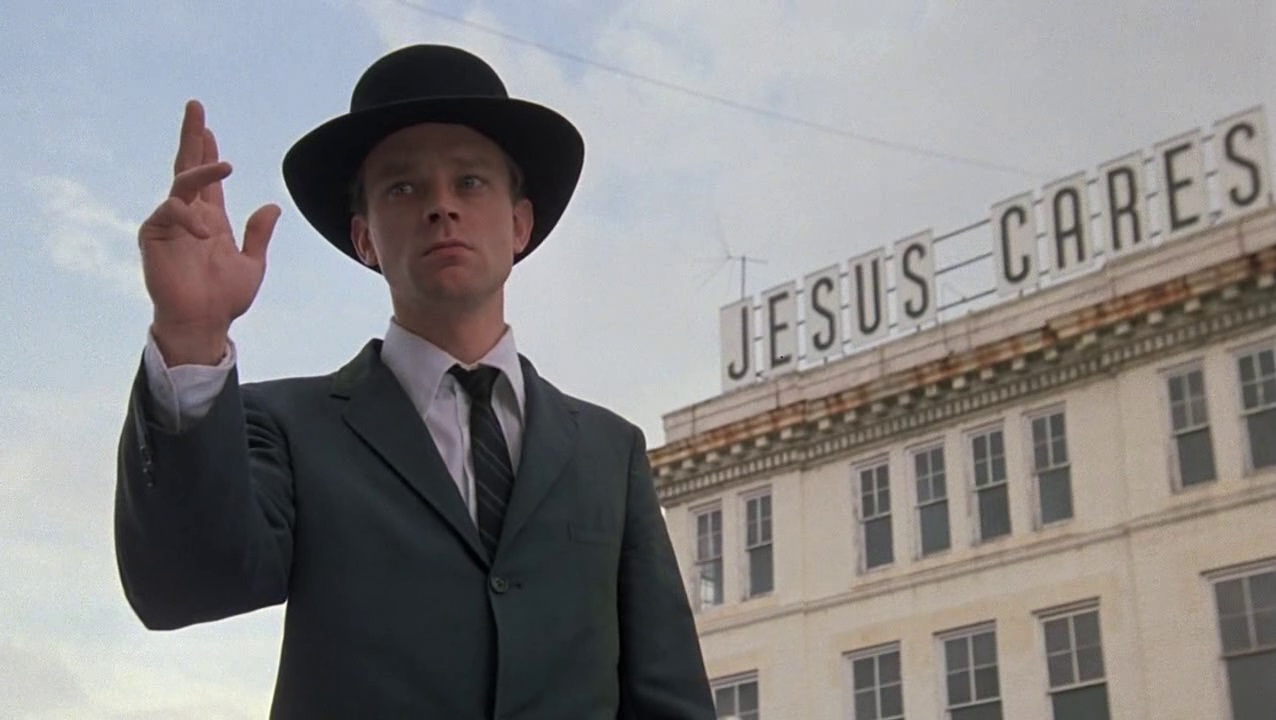
Brad Dourif in John Houston’s “Wiseblood” (1979).

“Wiseblood” is admittedly a difficult and troubling movie, based on a difficult and troubling book. But both book and movie shine with brilliance and are deserving of greater respect from Grisham, and TCM.

Grisham, I understand, is a religious man. Wikipedia cites him referring to his conversion to Christianity as “the most important event” in his life.

Flannery O’Connor was very devout as well. She was also not afraid to write about religion. In fact, the subject permeates her work. She was a Catholic, although her writing is predominantly about the lives and fates of southern Protestants. I’m not sure if O’Connor focused on religion so extensively because it was of tremendous personal importance to her … or because she recognized religion’s shaping influence across the southern states and thought that was something worth writing about.  Perhaps both. In any case, why is Grisham, a self-proclaimed religious fellow, not in greater sympathy with O’Connor’s writing?

The fact is, O’Connor’s religious south is far from a comforting place. It’s not full of genteel homilies out of Sunday school. It’s a fairly savage landscape, populated by often grotesque characters who are severely challenged with regard to such cardinal virtues as  compassion and concern for others. They are often ignorant and self-satisfied. Racism is taken as a given.

So is violence.  This is from her classic story, “A Good Man is Hard to Find”:

“She would have been a good woman,” The Misfit said, “if it had been somebody there to shoot her every minute of her life.”

In O’Connor’s world, life is short and stupid, but salvation, oddly enough, is around any corner. It comes at her characters like freight trains crashing through front parlor walls, taking them off guard, crushing them out of earthly existence, but bestowing that most valuable gift of enlightenment and grace, just when it is least expected.

O’Connor does not make religion, or the south, seem cozy or safe. Perhaps that’s what John Grisham doesn’t cotton to.

Said O’Connor about “Wiseblood”:

“It is a comic novel about a Christian malgre lui (in spite of himself), and as such, very serious, for all comic novels that are any good must be about matters of life and death.”

Not only did Grisham pass over O’Conner’s huge significance in 20th century literature, he also showed scant interest in the film’s director, John Houston, a monumental filmmaker who adapted Joyce and Melville and O’Connor and other literary heavyweights, with varying success. It seems unlikely Houston would have been interested in dramatizing one of Grisham’s potboilers.

But then, John Grisham has had 8 or 9 films made from his work, and Flannery O’Connor only one. I guess he gets the last laugh.

I’m just not sure TCM should have recruited him as an expert on great southern writers.  Let’s just say, if you ask me what is next in this sequence … William Faulkner, Flannery O’Connor, Harper Lee, _________ … my answer wouldn’t be: John Grisham.