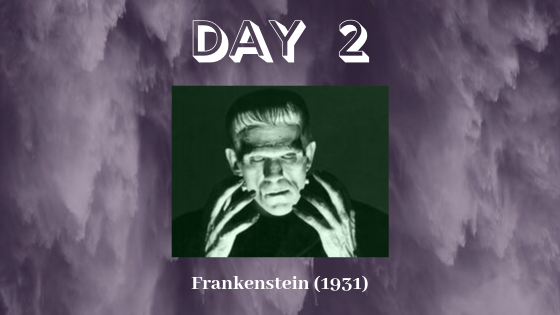
After Universal Studio’s success with DRACULA in early 1931, what could be more natural for a followup than to turn to Mary Shelley’s 1818 classic?
The novel is about a young Swiss scientist who bestows life upon a body he created by appropriating parts from rifled graves and other sources, only to have his creation turn against him and destroy all the scientist holds dear. A couple of silent film adaptations had been done, most notably one produced by Thomas Edison in 1910.
That Universal’s blood and thunder sound version of ’31 was released in November of seems appropriate, since that is the month of the monster’s creation in the novel:
“It was on a dreary night of November that I beheld the accomplishment of my toils. With an anxiety that almost amounted to agony, collected the instruments of life around me, that I might infuse a spark of being into the lifeless thing that lay at my feet. It was already one in the morning; the rain pattered dismally against the panes, and my candle was nearly burnt out, when, by the glimmer of the half-extinguished light, I saw the dull yellow eye of the creature open; it breathed hard, and a convulsive motion agitated its limbs.”
But what would the filmic monster look like? How would he be brought to life? (Shelley’s narrative provides few details on the procedure.) Director James Whale and electrical effects artist Kenneth Strickfaden contrived to stage an exciting creation sequence, with the table-bound monster being raised to the roof to receive the lightning’s gift of the mysterious life-giving ray that the scientist has discovered. The sequence is a cinematic triumph, its dazzling pyrotechnics effectively “selling” us on the unholy miracle of the monster’s birth.
Meanwhile, makeup artist Jack Pierce, also in consultation with director Whale, created a monster visage that audiences would fear and pity for generations to come. The genius of the makeup was to allow as much as possible for an actor’s expressive face to remain exposed. Struggling actor Boris Karloff won the role of the monster, partly on the basis of the unusual bone structure in his face and his large liquid eyes.
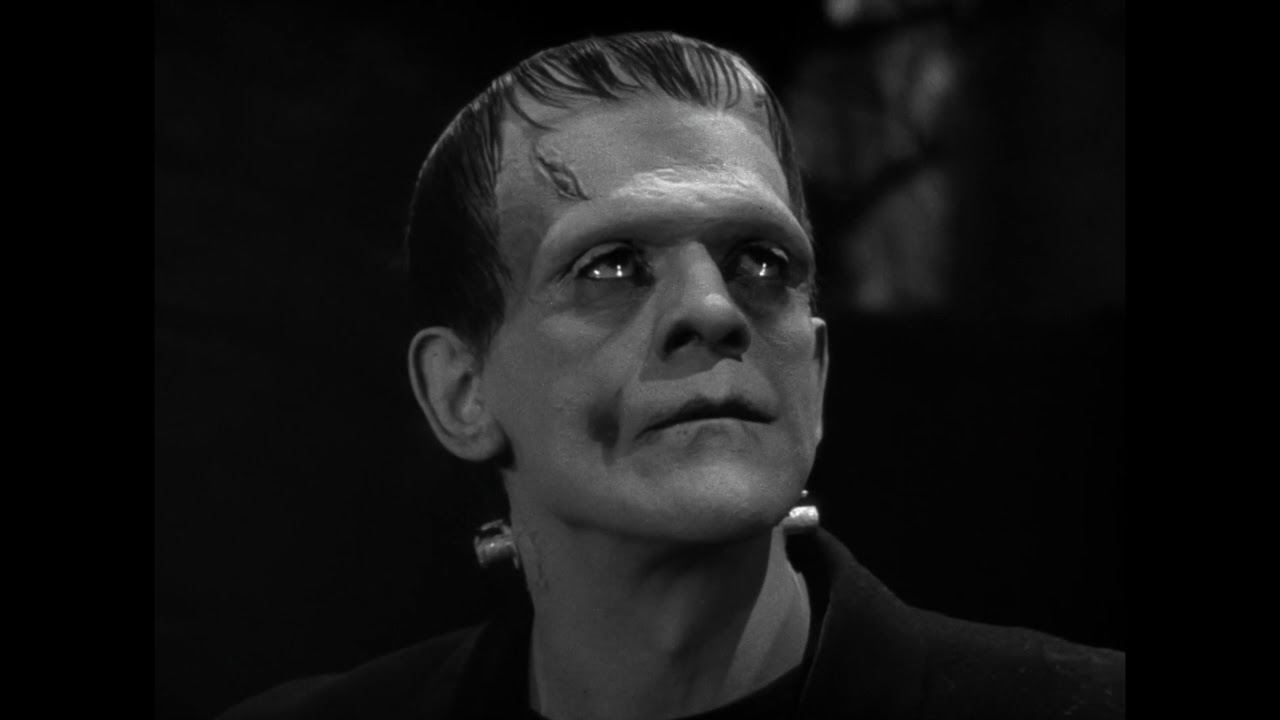
“Karloff’s eyes mirrored the suffering we needed,” said Universal exec Carl Laemmle.
Colin Clive, an actor who specialized in sensitive, high-strung roles, was a perfect fit for the scientist, Henry Frankenstein. (The name is inexplicably changed from the novel’s “Victor.”) His frenzied performance in the creation scene, accompanied by terrifying peals of thunder and an orgy of electrical sparks and buzzes, is unforgettable. (Note: as in DRACULA and other examples of early sound cinema, there is no musical score. These films breathe with eerie stretches of silence, helped by sound effects.)
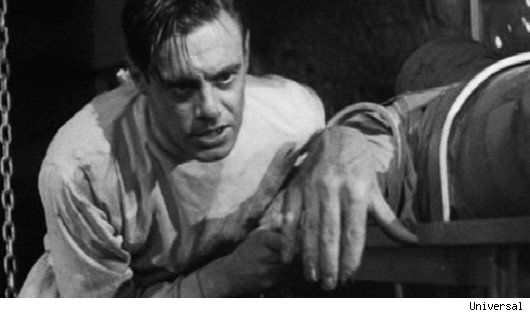
“It’s moving! It’s alive!”
HIGH POINTS
The creation scene remains a knockout to this day, as does the haunting vignette in which Karloff’s newly born creation reaches above his head for the light descending from a skylight as if he could grip it in his hands.
Karloff’s monster, quick, agile, clearly not sound of mind, immensely strong and unpredictable, with heavily lidded dead man’s eyes, is instantly frightening, making us feel we are looking upon a thing that should not be alive, but unaccountably is.

And yet the creature is immensely sympathetic, an unwanted child abandoned by his only parent, hated and feared by everyone else based on his grotesque appearance. In his ill fitting black, funereal suit , he carries with him the aura of the grave, evoking a universal dread. With his spasmodic movements, shuffling gate and pathetic, pleading hand gestures, he is one of horror’s supreme characterizations, simultaneously frightening and poignant. Other actors, including Christopher Lee, Michael Sarrazin, and Robert DeNiro have made sincere attempts to portray the monster. With respect, no one even comes close.
The film is a tragedy. Frankenstein, reduced to a nervous wreck by the shattering of his great dream, becomes a shell of the confident visionary we see in the early scenes. The monster is hounded to a horrifying death, caught in the inferno of a blazing mill.
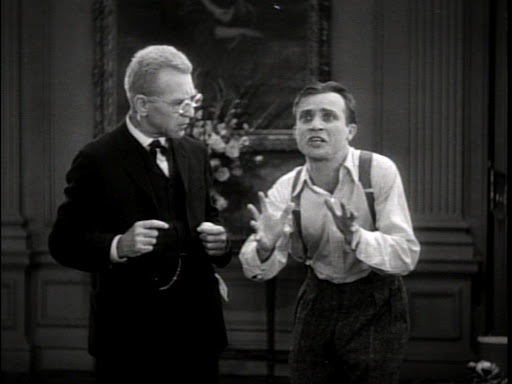
Clive and Karloff are ably assisted by two holdovers from DRACULA, Edward Van Sloan as Professor Waldman and Dwight Frye as Frankenstein’s hunchback assistant, Fritz. Also helping out are Mae Clarke as Frankenstein’s fiance, Elizabeth, John Boles as his friend, Victor, and Frederick Kerr as his father, the harrumphing old Baron.
The monster of course remains mute throughout the film. Most of the best dialogue belongs to the scientist:
(caressing the coffin of a stolen body) “He’s Just Resting, Waiting For A New Life To Come.”
“The brain you stole, Fritz. Think of it. The brain of a dead man waiting to live again in a body I made with my own hands!”
“Have you never wanted to do anything that was dangerous? Where should we be if no one tried to find out what lies beyond? Have your never wanted to look beyond the clouds and the stars, or to know what causes the trees to bud? And what changes the darkness into light? But if you talk like that, people call you crazy. Well, if I could discover just one of these things, what eternity is, for example, I wouldn’t care if they did think I was crazy.
DEFICITS
FRANKENSTEIN might not seem shocking today. Its monster makeup and Gothic trappings have been absorbed into the culture, its iconography made comfortable by parodies, pop songs and use in Saturday morning cartoons and breakfast cereals. But Whale’s Gothic extravaganza was considered unfamiliar, strong meat when first issued, with its corpse like monster, graveyard scenes, multiple murders and grim, fairy tale like setting.
Some cuts made at the preview stage, designed to protect delicate sensibilities, hurt the film for decades. For many of us who grew up watching it on television, the fabulous creation scene was marred by a jump cut at its climax, where a crucial but potentially blasphemous bit of the scientist’s dialogue — “Oh, in the name of God, now I know what it feels like to be God!” — was crudely excised. (Hey, it only expressed a major theme of the film.)
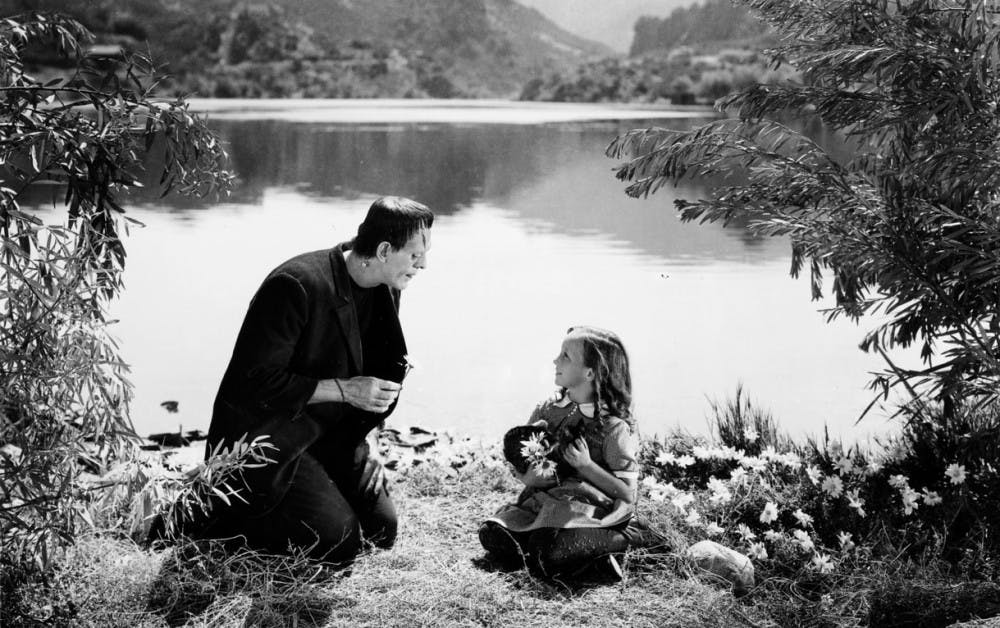
Similarly, the famous (or infamous) scene in which Karloff’s monster befriends a little girl, but ends up unintentionally drowning her, was truncated, cutting abruptly as Karloff reaches for her, which allowed for even worse implications than what was intended. The scene, fully restored a few decades ago along with Clive’s censored line and a few other bits and pieces, remains a touching, heartbreaking episode in the monster’s lonely existence, one tranquil moment of friendship and peace before tragedy and horror reassert themselves.
Despite one or two stuffy performances, including some weak comic relief from the Baron, and a few bits of unexplained plot construction (How does the monster know where Frankenstein lives?), the film remains a powerful experience, maybe not as shocking as it once was, but largely undiminished in its impact.
INTERESTING FACTS
- Karloff suffered severe back pains the rest of his life that may have resulted from the rigors of his performance, particularly the scenes in which he has to carry Clive on his back through the mountainous countryside.
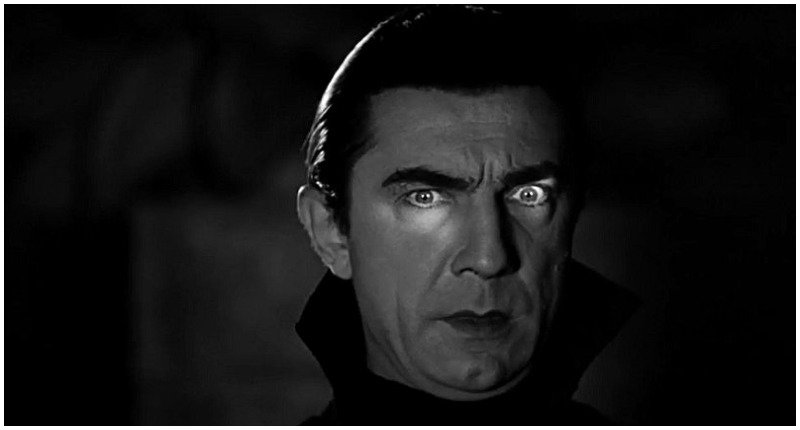
- DRACULA star Bela Lugosi was originally assigned the monster role, even trying out his own makeup, before Karloff was (wisely) brought in.
- Karloff, protective of the monster, played him in two sequels but stopped when he thought the character was being cheapened. He called the monster “my best friend.”
UP NEXT:
“My analysis of this soul , the human psyche, leads me to believe that man is not truly one – but, truly two. One of him strives for the nobilities of life. This we call his good self. The other, seeks an expression of impulses that bind him to some dim animal relation with the earth.”

 Write Yourself Sane