Thoughts on Writing

All posts in the Thoughts on Writing category

Public Reading of My Story

Published November 13, 2015 by Philip Ivory

On Nov. 7, 2015, I had the privilege of reading my short story, “Most of Us Are From Someplace Else,” at a public event held by the Writers Studio Tucson.

I’m in the advanced class of Writers Studio, and was eligible to enter the 2015 Write-to-Read competition.  I was honored to be named one of three winners, along with Jenny Hedger and Lisa Harris.  The judge was Tucson novelist and friend of the Writers Studio Adrienne Celt.  Here we are all together last Saturday:

Write to Read Group Shot cropped

At Tucson’s first Write-to-Read Event. From left to right: Jenny Hedger, Lisa Harris, Adrienne Celt and Phil Ivory. (Photo by Writers Studio Tucson.)

We had an excellent turnout, so good in fact that many had to stand while the three stories were read.  I want to thank my good friends who came out to support me and other writers.

The Writers Studio Tucson is doing a great job putting together public events like this to encourage the growth of local writers.

11216807_10153437065773300_4654595010877294541_n

Lots of literary Tucsonans turning out for the 2015 Write-to-Read event on Nov. 7. (Photo courtesy of Kim Kloes.)

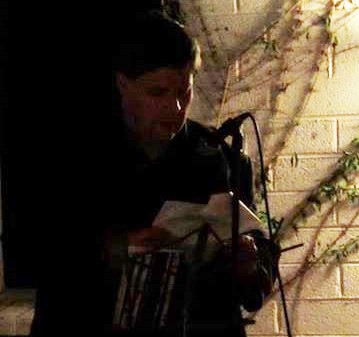
Reading my story was a very rewarding experience. It was a little nerve-wracking at first, looking out at so many faces and not knowing if people were enjoying or even following my story. But I started to hear laughter at some appropriate points and I knew that the audience was with me. After that, I was able to relax a bit and enjoy the experience.
12208342_924308887663661_6053684122001127975_n cropped - Copy

Phil Ivory. (Photo courtesy of Kim Kloes.)

I know, as a listener, it can be hard to follow a story being read. Become distracted for a moment and you can lose the whole thread, and there’s no paging back to reclaim your bearings. So I tried to read as clearly and deliberately as possible.

I got lots of positive feedback afterwards, both on the read and the story itself, and I’ll be submitting the story for publication shortly.

Congratulations to my fellow writers, and special thanks to Adrienne as well as Writers Studio teachers Renee Bibby, Janelle Drumwright and Lela Scott MacNeil for putting this fantastic event together.
John Grisham on “Wiseblood”

Published November 11, 2015 by Philip Ivory

Feeling annoyed ….

Today Turner Classic Movies is showing films based on books by great southern writers. Author John Grisham was roped in to help TCM host Robert Osborne do intros and outros for the films, presumably because Grisham is considered a modern southern writer.

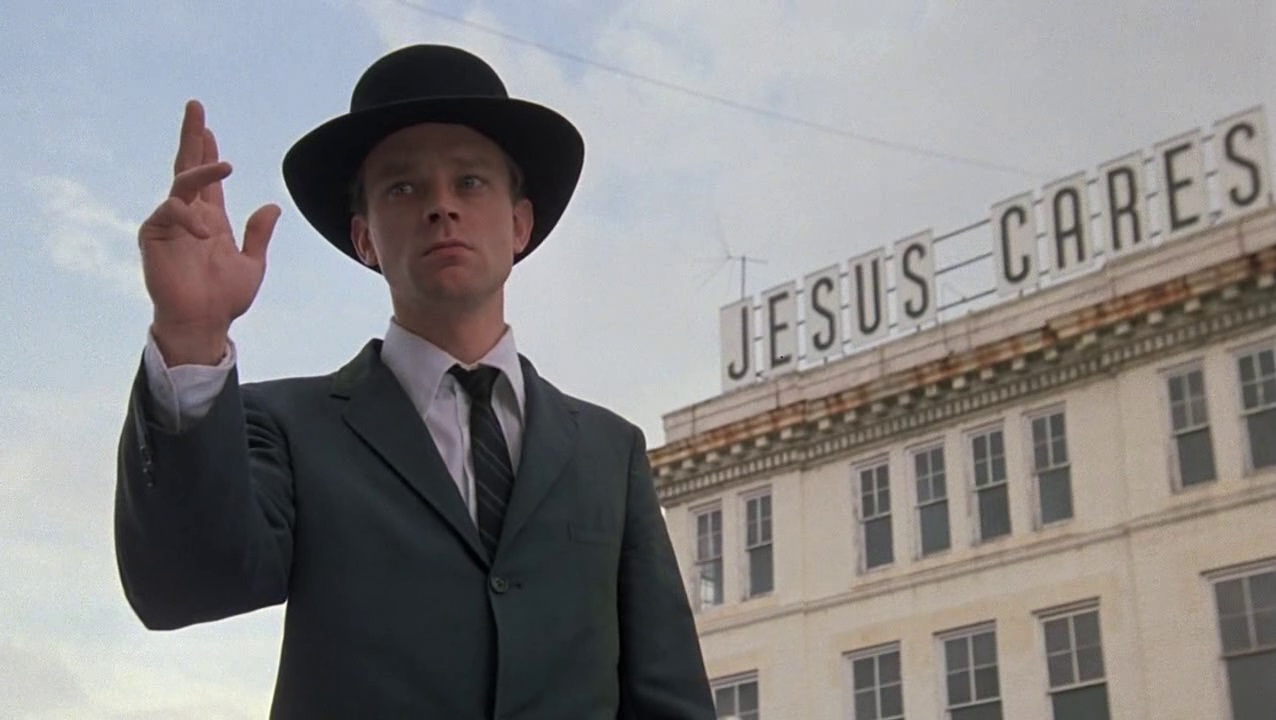
I just watched Grisham’s comments about one of my favorite oddball movies from the 70s, “Wiseblood” directed by the great John Houston, and based on the novel (mistakenly referred to by Grisham as a short story) by the great Flannery O’Connor.

After the movie finished, Osborne asked Grisham why he was grumbling … yes grumbling … during the screening, and Grisham went on to complain about the film having too much religion (a little like blaming Moby Dick for having too much whale) and then talked in a dismissive way about the proclivity of old time southern writers to deal too much with religion. He had nothing to say about O’Connor herself, whose short stories command respect for her peerless mastery of the form.

Brad Dourif in John Houston’s “Wiseblood” (1979).

“Wiseblood” is admittedly a difficult and troubling movie, based on a difficult and troubling book. But both book and movie shine with brilliance and are deserving of greater respect from Grisham, and TCM.

Grisham, I understand, is a religious man. Wikipedia cites him referring to his conversion to Christianity as “the most important event” in his life.

Flannery O’Connor was very devout as well. She was also not afraid to write about religion. In fact, the subject permeates her work. She was a Catholic, although her writing is predominantly about the lives and fates of southern Protestants. I’m not sure if O’Connor focused on religion so extensively because it was of tremendous personal importance to her … or because she recognized religion’s shaping influence across the southern states and thought that was something worth writing about.  Perhaps both. In any case, why is Grisham, a self-proclaimed religious fellow, not in greater sympathy with O’Connor’s writing?

The fact is, O’Connor’s religious south is far from a comforting place. It’s not full of genteel homilies out of Sunday school. It’s a fairly savage landscape, populated by often grotesque characters who are severely challenged with regard to such cardinal virtues as  compassion and concern for others. They are often ignorant and self-satisfied. Racism is taken as a given.

So is violence.  This is from her classic story, “A Good Man is Hard to Find”:

“She would have been a good woman,” The Misfit said, “if it had been somebody there to shoot her every minute of her life.”

In O’Connor’s world, life is short and stupid, but salvation, oddly enough, is around any corner. It comes at her characters like freight trains crashing through front parlor walls, taking them off guard, crushing them out of earthly existence, but bestowing that most valuable gift of enlightenment and grace, just when it is least expected.

O’Connor does not make religion, or the south, seem cozy or safe. Perhaps that’s what John Grisham doesn’t cotton to.

Said O’Connor about “Wiseblood”:

“It is a comic novel about a Christian malgre lui (in spite of himself), and as such, very serious, for all comic novels that are any good must be about matters of life and death.”

Not only did Grisham pass over O’Conner’s huge significance in 20th century literature, he also showed scant interest in the film’s director, John Houston, a monumental filmmaker who adapted Joyce and Melville and O’Connor and other literary heavyweights, with varying success. It seems unlikely Houston would have been interested in dramatizing one of Grisham’s potboilers.

But then, John Grisham has had 8 or 9 films made from his work, and Flannery O’Connor only one. I guess he gets the last laugh.

I’m just not sure TCM should have recruited him as an expert on great southern writers.  Let’s just say, if you ask me what is next in this sequence … William Faulkner, Flannery O’Connor, Harper Lee, _________ … my answer wouldn’t be: John Grisham.

Writers Studio: My First Contest Win

Published November 6, 2015 by Philip Ivory

Very excited … I recently submitted a story to the Writer Studio Tucson’s first “Write to Read” Contest.  My entry,”Most of Us Are From Someplace Else,” was chosen as one of the winners.  That means I get to read my story in its entirety at a public event tomorrow night here in Tucson.

I’m grateful to the teachers at Writers Studio Tucson for helping me grow as a writer and for spearheading this contest and hosting the reading.  Also, thanks to local author Adrienne Celt for creating the writing prompt for the contest, which reflected structural elements in her fine novel, “The Daughters,” available on Amazon.

Looking forward to seeing many fellow writers and other friends at the reading tomorrow.

You can read the contest announcement below:

 Write to Read Announcement 3

FROM WRITER STUDIOS TUCSON:
The Writers Studio Tucson teachers are excited to announce our first ever Write-to-Read contest, featuring guest judge Adrienne Celt, whose debut novel The Daughters was published in 2015.

Join us for a reading of the three winning stories! Lisa Harris reading “Spilled Milk”; Phil Ivory “Most of Us Are From Someplace Else”; and Jenny Hedger reading “Threads.”

As We Write, We Create Ourselves

Published August 6, 2015 by Philip Ivory

“From a very early age, perhaps the age of five or six, I knew that when I grew up I should be a writer. Between the ages of about seventeen and twenty-four I tried to abandon this idea, but I did so with the consciousness that I was outraging my true nature and that sooner or later I should have to settle down and write books.”
George Orwell, “Why I Write

I’ve worked as a professional writer for 30 years, since graduating from Columbia in 1985. I make my living in what they now call marketing writing, but what used to be called other things like public relations or copywriting. I live in that world 8 hours a day.

At the end of that day, I want to work on something else, something closer to my heart: fiction writing. I’ve dabbled in it all my life, off and on, but, now in my early 50s, I’m feeling a new commitment to it. About a year ago, I plunged back into it, thanks to some help from some good friends, a very good reading/writing group, and an excellent writing class here in Tucson, AZ, where I reside.

The thWYSing is, for the better part of a decade prior, I was not writing. Nothing felt good. Sometimes I strapped myself in for Nanowrimo (that’s National Novel Writing Month). I’d write my 50,000 words in the 30 days of November but end up with an ungainly mess that I could barely stand to look at, a child I’d rather leave on someone’s doorstep than take responsibility for. Sporadically, I’d produce a globule of writing, which would end up residing uneasily on my hard drive, not knowing if it was wanted or not.

The years when I wasn’t writing productively were bad. I felt lost. I had a job, and family. But no purpose. And no sense of my own identify. I was just a guy taking up space in the world, like the writing fragments taking up space on my computer.

But when I started writing again, I found myself again. As the writing muscles flexed, and the words began to flow, I felt as if my very life juices were beginning to flow again. I knew who I was. Why I was on this planet.

That’s what I want this blog to be about. Sure, there are many reasons to write. Fame. Fortune. Sex. Money. In that order. (Actually, if it’s those four things, any order will do.)

But the best reason to write is to stay sane.

Yes, sane. After all, it’s a tough world out there. It’s not always fun. The news is wall to wall with hatred and craziness. It’s a Kellogg’s Variety Pack of shame, violence, inhumanity, vulgarity and Kardashians.

The world can wear you down, trample on your joi de vivre and take the starch out of your sunflower. If you are meant to write, born to write, I believe you will lose your sense of self if you fail to do so. In Orwell’s words, you will outrage your true nature.

As Ray Bradbury said: “You must stay drunk on writing so reality cannot destroy you.”
(Thank you, Mr. Bradbury. I was lucky enough to hear you speak once, and I’ll never forget it.)

That’s what I’m going to try to do this with this blog, jotting down thoughts on writing, some heady and high flying, some practical and soil-based.

I’ll talk about books I’ve read, movies I’ve seen. Conversations I’ve had. Classes I’ve taken. Journals I’ve submitted stories to. Anything that feeds the spirit and charges up the creative batteries, and leads you to write, write, write.

I have a corollary to Bradbury’s sentiment, a parallel sentiment but one perhaps with larger implications for leading a satisfactory life. It’s a motto to remember for any of us who have carried around large baggage, letting the weight stifle our heartsongs from ringing out loud and clear.

In the Gnostic text known as the Gospel of Thomas, Jesus says: “If you bring forth what is within you, what you bring forth will save you. If you do not bring forth what is within you, what you do not bring forth will destroy you.”

So bring forth. Write. Yourself. Sane.


← Back

Thank you for your response. ✨